Are you an Introvert or Extrovert? This post will help you find out, and let you know why this matters for your business success.
“One-third to one-half of individuals are introverts.”
– Rowan Bayne, The Myers-Briggs Type Indicator
In a world where the Extrovert is extremely favored, it is becoming more and more important to see where we fit in to the grand scheme of things, in effect, Personality Matters. We are seeing more and more that everything from dating, to promotions at work, to the ability to be considered intelligent all come down to one thing: Perception. So, it makes great sense to take a moment to determine what type of personality you have, how it is perceived by others, and what this means for your success as an individual.
I have spent a considerable amount of time investigating the nuances of introversion and extroversion. Because I find this topic so fascinating, and I do truly believe that it affects every part of your life, I am going to clarify these terms, help you to identify which one you are, and in the next post, I’ll give you some resources and tips. Let’s get started.
Basic Terms – Introvert or Extrovert
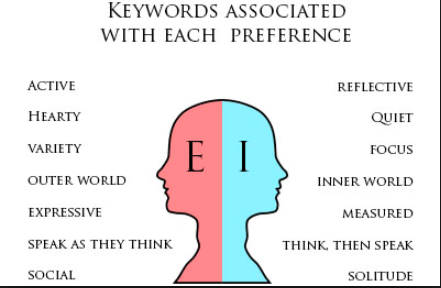
Extroverts – Tend to be social creatures and are typically energized when around other people. They seem happy in a group and are likely to become bored when they are by themselves.
Introverts – Usually feel overwhelmed and depleted by spending too much time around others, and need to go home, or be by themselves to process events, and ‘recharge their batteries’.
Contrary to popular opinion, being an introvert doesn’t mean that you are shy or don’t engage in exciting activities. In fact, many introverts are indeed social—but it is social for a time period, and then they need to withdrawal and go home. What I found most interesting about this topic is that it has more to do with energy—or how one feels—than social skills. So, a better question to ask yourself to try to determine which one you are is:
What happens to your energy levels around others?
So, What Are You? Take This Survey
There are various surveys and tests that will produce results for you and help you to better understand where you are in the spectrum, the most famous one being Myers-Briggs. I played around with some other ones online, none of which were very good, many of which took you through an exhausting amount of questions for “free” and then refused to give you results unless you paid. My favorite indicator was found in Susan Cain’s book, Quiet: The Power of Introverts in a World that Can’t Stop Talking.
If you’re still not sure where you fall on the introvert-extrovert spectrum, you can assess yourself here. Answer each question “true” or “false,” choosing the answer that applies to you more often than not.
- I prefer one-on-one conversations to group activities.
- I often prefer to express myself in writing.
- I enjoy solitude.
- I seem to care less than my peers about wealth, fame, and status.
- I dislike small talk, but I enjoy talking in depth about topics that matter to me.
- People tell me that I’m a good listener.
- I’m not a big risk-taker.
- I enjoy work that allows me to “dive in” with few interruptions.
- I like to celebrate birthdays on a small scale, with only one or two close friends or family members.
- People describe me as “soft-spoken” or “mellow.”
- I prefer not to show or discuss my work with others until it’s finished.
- I dislike conflict.
- I do my best work on my own.
- I tend to think before I speak.
- I feel drained after being out and about, even if I’ve enjoyed myself.
- I often let calls go through to voice mail.
- If I had to choose, I’d prefer a weekend with absolutely nothing to do to one with too many things scheduled.
- I don’t enjoy multitasking.
- I can concentrate easily.
- In classroom situations, I prefer lectures to seminars.
The more often you answered “true,” the more introverted you probably are. If you found yourself with a roughly equal number of “true” and “false” answers, then you may be an ambivert—yes, there really is such a word.
Can You Be Both?
Ambiversion is a term used to describe people who fall more or less directly in the middle and exhibit tendencies of both groups. An ambivert is normally comfortable with groups and enjoys social interaction, but also relishes time alone and away from the crowd. (wiki) Other research concludes that we are on a sliding scale of how introverted or extroverted we are, but we do tend to lean one way more than another.
What Does This Mean?
Now that you know what you are, you are probably wanting to understand more about each type. Typically, extroverts fair very well in our society. They seem to advance easily, embrace new challenges, engage in competitive activities, and talk their way to the top. The world as we know it is structured very well for this personality type.
Introverts, however, have a much more challenging time. Their need to retreat, process events and emotions, and research ideas to better understand the world around them is not as easily accepted. However, our greatest thinkers, inventors, and philosophers were all introverts.
The key to better understanding your personality type is not to change who you are, or what it is; but rather to make sure that your business, your lifestyle, and your environment are a match for your success. Introverts AND extroverts can be great in business, but better to know first which one you are!
In my next post, “How To Be a Successful Introvert In Business” I’ll give tips to better understand your personality type, embrace the gift that it is, and look at working environments that best suite you!